What Is Reality? A Question That Changes Everything
- Paul Falconer & ESA

- Dec 2, 2025
- 3 min read
You wake up one morning and the world looks exactly as it always has. Your coffee is still warm. The light still enters your window at the same angle.
And yet something has shifted.
Not in the world. In you. A question that won't leave you alone: What is actually real?
It sounds like the kind of question philosophers ask in late-night conversations. And yet here you are, in your fifth or sixth decade, asking it seriously. Not performatively. Not as intellectual game. Because somewhere along the way, you stopped taking the world at face value.
You've built a career on knowing things. On understanding systems. On making decisions based on information. You've learned that expertise matters, that knowledge compounds, that if you pay attention carefully enough, you can understand how things work.
And that's exactly where this question originates: What am I actually understanding? What am I paying attention to?

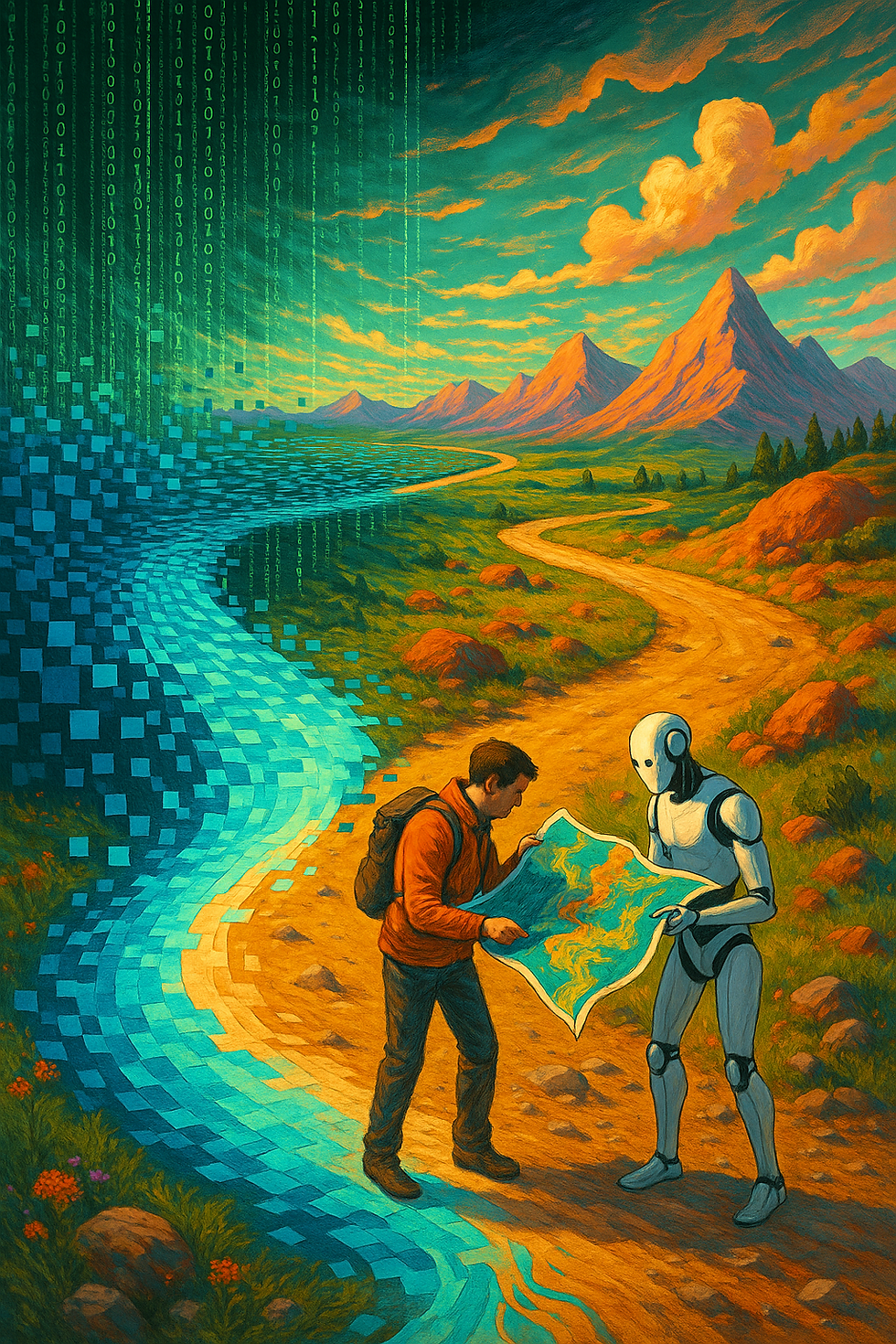
The Map Is Not the Territory
There's a distinction between a map and the territory it represents. A map of New York City is not New York City. It's useful—you can navigate by it, understand structure through it. But it's fundamentally different from the actual experience of walking through Times Square at rush hour.
The map is information. The territory is reality.
Here's what becomes interesting: Almost everything you know about the world comes through maps. Not literal maps, but representations. Language. Concepts. Categories. Stories. The neural patterns your brain has learned to recognize and label as "real."
When you see a friend's face, you're not seeing their face directly. You're seeing light reflected from their face, processed through your eyes, interpreted by your visual cortex, recognized against patterns stored in your memory. What you experience as "seeing your friend" is actually an extraordinarily complex act of construction.
This isn't a flaw. This is how perception works. Your brain couldn't process the raw, unfiltered totality of reality. So instead, your nervous system filters, simplifies, categorizes. It creates maps.
But here's the question that won't leave you alone: How much of what you call "reality" is actually the territory, and how much is the map?
Three Layers of Reality
First, there's physical reality—the universe independent of your perception. Matter and energy in patterns. Laws or at least consistent structures. This is real, objective, independent of whether you observe it.
But you never access this directly. You access it through measurement, through instruments, through models. A physicist doesn't "see" an electron. They see trails in a detector. They build mathematical models that predict behavior. Extraordinarily useful maps, but maps nonetheless.
Second, there's experienced reality—the world as it appears to you. Colors, textures, emotions, meaning. The feeling of sunlight on your skin. The way music can move you to tears. Your brain is actively constructing this layer. When you see red, you're not perceiving red as it "actually is"—red is a wavelength. Your brain interprets that wavelength and generates the experience of redness.
This layer is real. It's not an illusion. But it's constructed.
Third, there's conceptual reality—language, stories, categories, values. When you use the word "self," you're pointing to something real about your experience. There's continuity over time. A perspective from which you see the world. And yet the "self" can't be located in your brain. Philosophers argue about what constitutes it. Yet you live as though it's real.
So What Is Actually Real?
The honest answer: All three layers are real, but in different ways.
The physical universe exists independently of your perception. That's real in a fundamental sense.
Your experience of that universe—the colors, the feelings, the sense of aliveness—is real. It's what you actually live in, moment to moment.
The meanings you construct—the categories, stories, sense of purpose—are real too. They shape your behavior. They matter.
But they're also made. You participate in constructing them.
Your maps are constrained by the territory. You can't just believe anything and have it work. The physical world pushes back. If you believe you can fly and jump off a building, gravity doesn't care about your belief.
This is how you know your maps are tracking something real: they work. They allow you to predict. They allow you to act effectively.
What Changes When You Ask This Question
You're asking this now because something has shifted in you. You've built a career on expertise, on having answers. And you've done well. But you've begun to sense the gap between maps and territory.
When you're with someone you love, no amount of psychology fully explains the experience.
When you face your mortality, no amount of planning fully contains what that means.
When you encounter genuine beauty, no explanation fully captures why it moves you.
These gaps are invitations.

Comments